Night Operations: When Darkness Changes the Rules
Shooting accurately on a well-lit range is one thing. Detecting, identifying and correctly assessing a potential threat in a dark environment is something entirely different.
When the light disappears, even skills that have been thoroughly practised during daylight become more difficult to perform. Visual perception changes, spatial awareness becomes more challenging, communication between team members becomes even more important, and improper use of light can reveal your own position.
This is why professional Night Operations Training involves far more than simply shooting in the dark.
It combines a range of skills including observation, identification, movement, communication, the controlled use of artificial light, night vision devices and thermal systems, as well as decision-making in an environment where significantly less visual information is available.
For military personnel, law enforcement officers, close protection operators, members of specialised units and security professionals working in high-risk environments, the ability to operate effectively at night is not merely an additional skill. In certain operational environments, it is an essential part of professional preparedness.
Why Does Darkness Change Everything?
Human vision functions most effectively when sufficient light is available. As illumination decreases, so does the amount of visual information the brain receives from the surrounding environment.
The result is greater uncertainty.
Distances may appear different. Shapes and outlines become harder to recognise. People and objects may blend into the background. Obstacles can be detected later. Part of the peripheral visual information we normally rely on may disappear.
But the most important challenge is not simply being able to see.
The real challenge is correctly understanding what you are seeing.
In a real-world situation, identification is more important than speed. An unclear silhouette is not automatically a threat. Movement in darkness does not provide sufficient information about a person’s intentions. An object in someone’s hand must be identified before an accurate assessment of the situation can be made.
This leads to one of the fundamental principles of operating in limited visibility:
Before you react, you must be able to identify.
This is where the difference between conventional firearms training and professional Low-Light / No-Light Training begins.
Low-Light and No-Light Are Not the Same
The terms are often used together, but they describe different environmental conditions.
Low-Light – Operating in Limited Illumination
A low-light environment could be a street at night, a poorly illuminated building, a car park, warehouse, wooded area, vehicle or room with limited sources of light.
In these conditions, the operator still has access to some visual information, but it may be insufficient, inconsistent or unevenly distributed.
The contrast between illuminated and dark areas can itself become misleading. A bright light source in one part of the visual field may make it considerably more difficult to perceive what is happening elsewhere.
No-Light – Operating in Near-Total Darkness
Under no-light conditions, natural vision no longer provides sufficient information to perform a task effectively.
Other tools then become increasingly important, including artificial illumination, night vision devices, infrared systems and thermal optics.
Technology, however, does not eliminate the problem.
It simply changes the way the operator must solve it.

A Tactical Flashlight Is a Tool, Not Simply a Source of Light
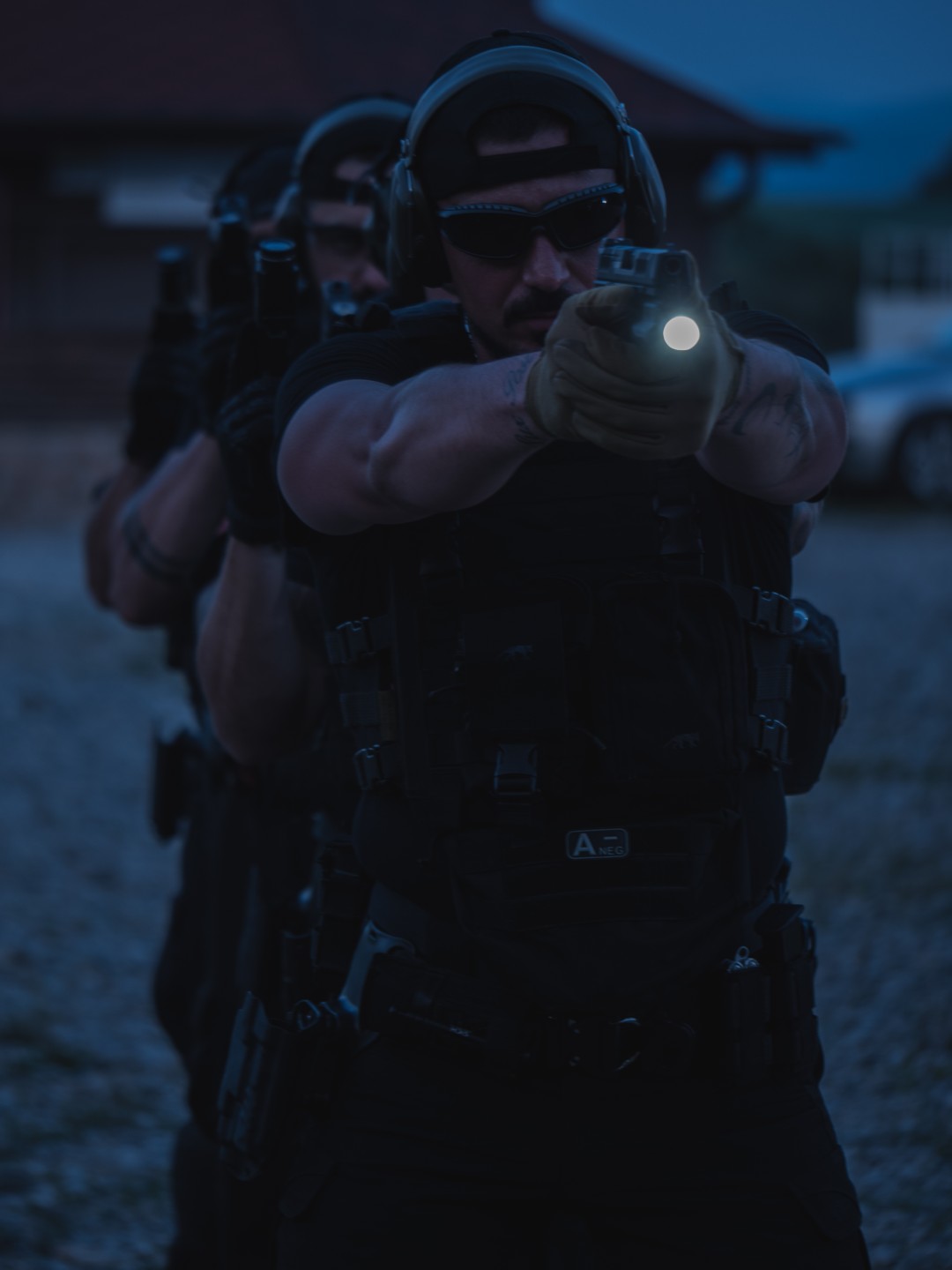
One of the first pieces of equipment associated with Low-Light Training is the tactical flashlight.
At first glance, its purpose seems obvious: illuminate the environment.
In a professional setting, however, light has to be managed.
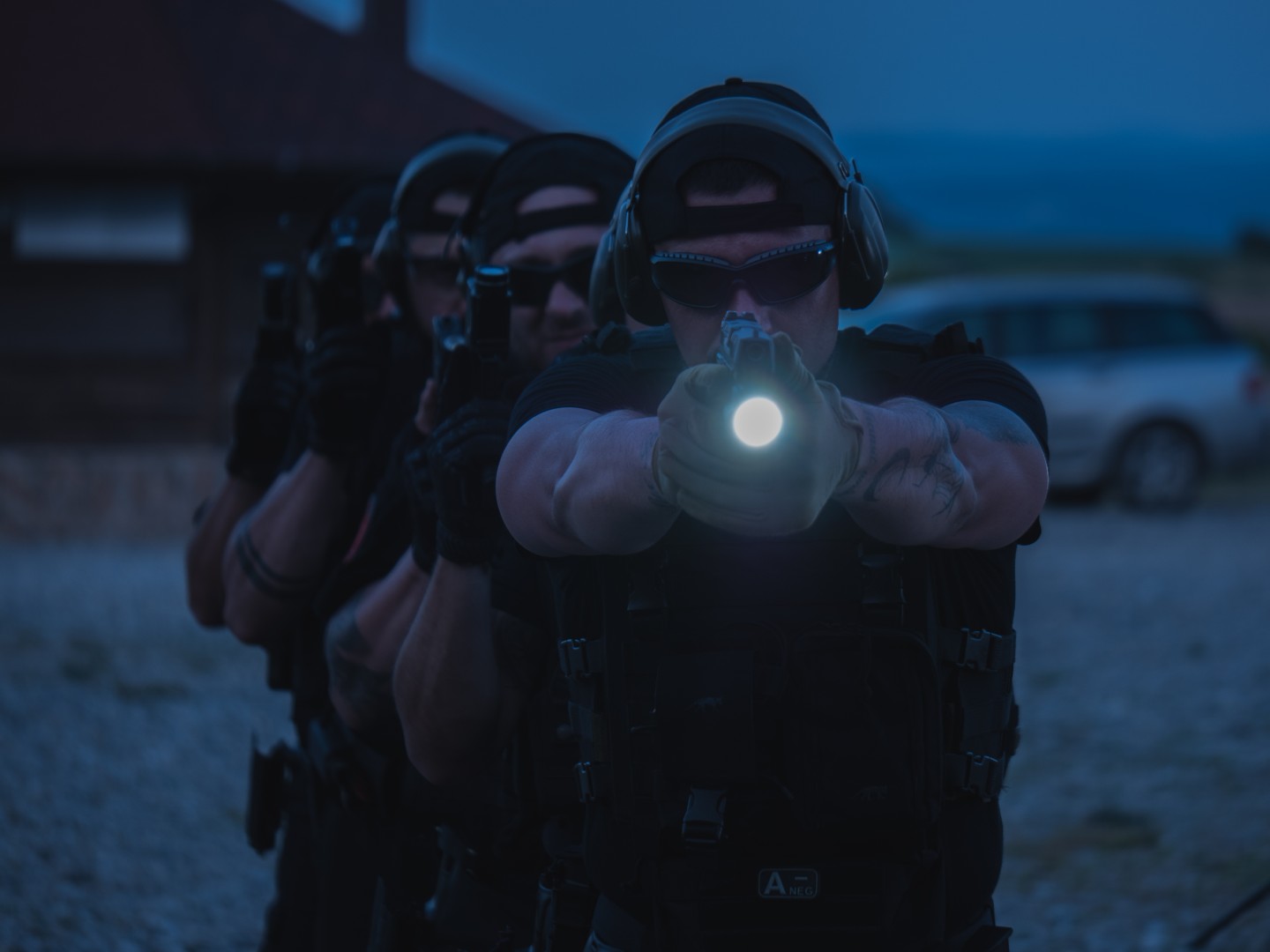
It can assist with detection and identification, improve orientation and help the operator control the environment. At the same time, it may reveal the operator’s position, affect the eyes’ adaptation to darkness or create reflections from walls, glass and other surfaces.
Low-Light Training therefore does not simply teach an operator how to switch on a flashlight. It develops an understanding of when light is required, why it is required and how it should be managed.
That is a significant distinction.
Through properly structured training, the student gradually learns to regard light as a resource that should be used deliberately rather than continuously.
Night Vision: Seeing in the Dark Does Not Mean Seeing Normally
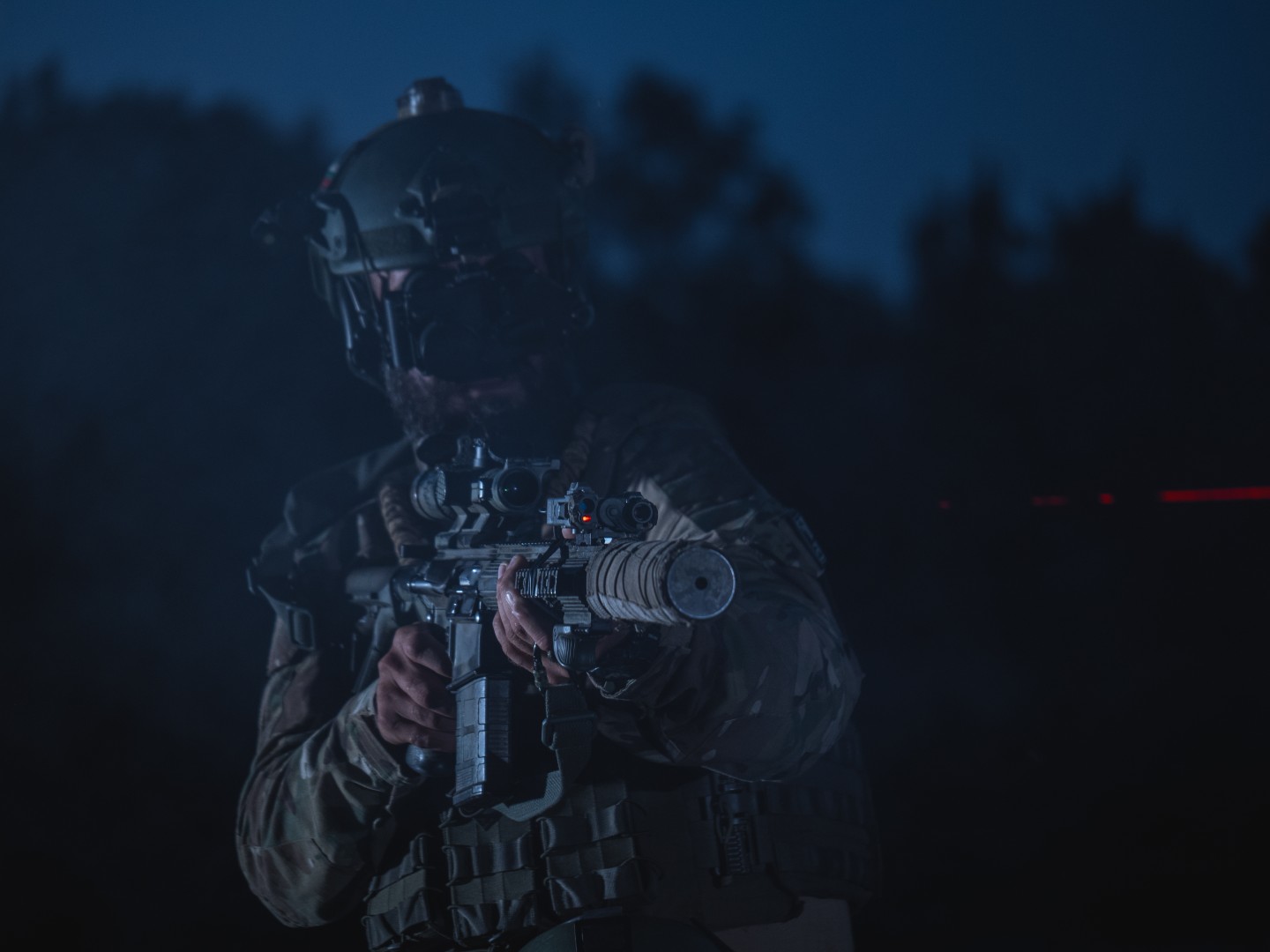
Night vision devices – including NVGs (Night Vision Goggles) and other image-intensification systems – provide a major advantage when operating at night.
But they also have limitations.
The image viewed through an NVG system is not identical to normal human vision. Depth perception, detail and peripheral awareness may differ. Tasks that appear straightforward during daylight – moving through terrain, negotiating obstacles, handling equipment or communicating with a partner – may require significant adaptation.
This is precisely why owning expensive equipment does not automatically mean being capable of using it effectively.
Technology does not replace training.
It is a tool that must be integrated into an already established foundation of professional skills.
Night Vision vs Thermal Optics: What Is the Difference?
Night vision and thermal imaging systems are frequently grouped together, but they operate according to different principles.
Night Vision Devices
Night vision systems amplify available light, allowing the operator to obtain a clearer visual picture in dark environments.
They can be particularly valuable for movement, navigation, orientation and observation.
Thermal Imaging Systems
Thermal optics do not rely on visible light in the same way. Instead, they visualise differences in the thermal radiation emitted by objects.
This can significantly assist in detecting a person or another source of heat within a particular environment.
However, detection and identification are not the same thing.
A thermal image may indicate the presence of an object, but correctly determining what that object is and understanding what is happening around it remains the responsibility of the operator.
For this reason, professional training should treat these technologies as complementary tools rather than universal solutions.
Shooting at Night Is Only One Part of Night Operations
When people think about tactical training at night, shooting in darkness is often the first thing that comes to mind.
But shooting is only one component.
Before a shot can even become relevant, the operator must be able to perceive the environment, recognise a potential threat, establish the position of other people, communicate and make an appropriate decision.
Limited visibility makes numerous tasks more difficult, including:
- spatial orientation;
- observation and identification;
- safe movement;
- handling equipment;
- communication between team members;
- effective use of cover;
- transitioning between illuminated and dark areas;
- managing personal light sources;
- decision-making under pressure.
This is why professional Night Operations Training should progressively develop from individual technical skills towards more complex and integrated scenarios.
What Happens to Skills You Already Have?
One of the most valuable aspects of Night Operations Training is that it quickly reveals how deeply fundamental skills have actually been learned.
An action that a student performs confidently during daylight can become considerably slower when they can no longer clearly see their own equipment.
The same applies to movement, communication and orientation.
This is one of the reasons why advanced training should never replace fundamental training.
It should build upon it.
A strong foundation in safe firearms handling, shooting, movement and communication allows the operator to focus attention on the new challenge: limited visual information.
If basic actions still require constant conscious attention, adding darkness, specialised equipment and stress only increases the likelihood of errors.
CQB at Night: Complexity Increases
In CQB (Close Quarters Battle), operators work in confined environments where decisions often have to be made rapidly and distances are typically short.
Adding limited visibility increases the complexity significantly.
Indoor environments contain numerous surfaces capable of reflecting light. Shadows may conceal important details. Light sources may be positioned behind the operator, directly ahead or outside the room. One part of the environment may be illuminated while another remains almost completely dark.
This is why CQB at night is not simply daytime CQB with the lights switched off.
Observation, communication, movement and the use of equipment all have to be adapted to the specific environment.
For trained professionals, night CQB is a logical progression once a solid foundation in tactical shooting and CQB has already been established.
Communication Becomes Even More Important
As visual information decreases, an operator loses part of the ability to continuously monitor the actions and positions of other team members.
This increases the importance of clear communication and established procedures.
When operating as part of a team, every member must understand their own task, their position in relation to others and the actions expected of them.
This becomes particularly important in complex environments such as buildings, wooded terrain, protected facilities, vehicle-based scenarios or operations involving several people working simultaneously.
Darkness punishes chaos.
The less information that is visually available, the more important discipline, communication and coordination become.
Tactical Medicine at Night
Limited visibility affects more than movement and shooting.
Providing medical assistance to an injured person also becomes considerably more difficult.
The casualty’s condition has to be assessed, injuries must be located, medical equipment must be used correctly and, when necessary, evacuation must be organised – sometimes under minimal illumination and in an environment that may itself remain hazardous.
This is why night scenarios also have an important role in tactical medical training.
A professional must be capable not only of knowing the appropriate medical procedures, but of applying them when conditions are far from ideal.
Internal link: Tactical Medicine Training – Alfa-Metal
Who Can Benefit from Night Operations Training?
Night Operations Training is particularly relevant for professionals whose duties may continue regardless of the time of day or available illumination.
These include military personnel, members of specialised law enforcement units, close protection operators, private military contractors, security personnel and other professionals working in high-risk environments.
For these professionals, darkness cannot simply be a reason to postpone the task until morning.
At the same time, specialised low-light training should never be considered a substitute for fundamental preparation.
Participants should already possess the required level of safe firearms handling and basic shooting competence before limited visibility, specialised equipment and more complex tactical scenarios are introduced.
From Daytime Training to Realistic Operational Environments
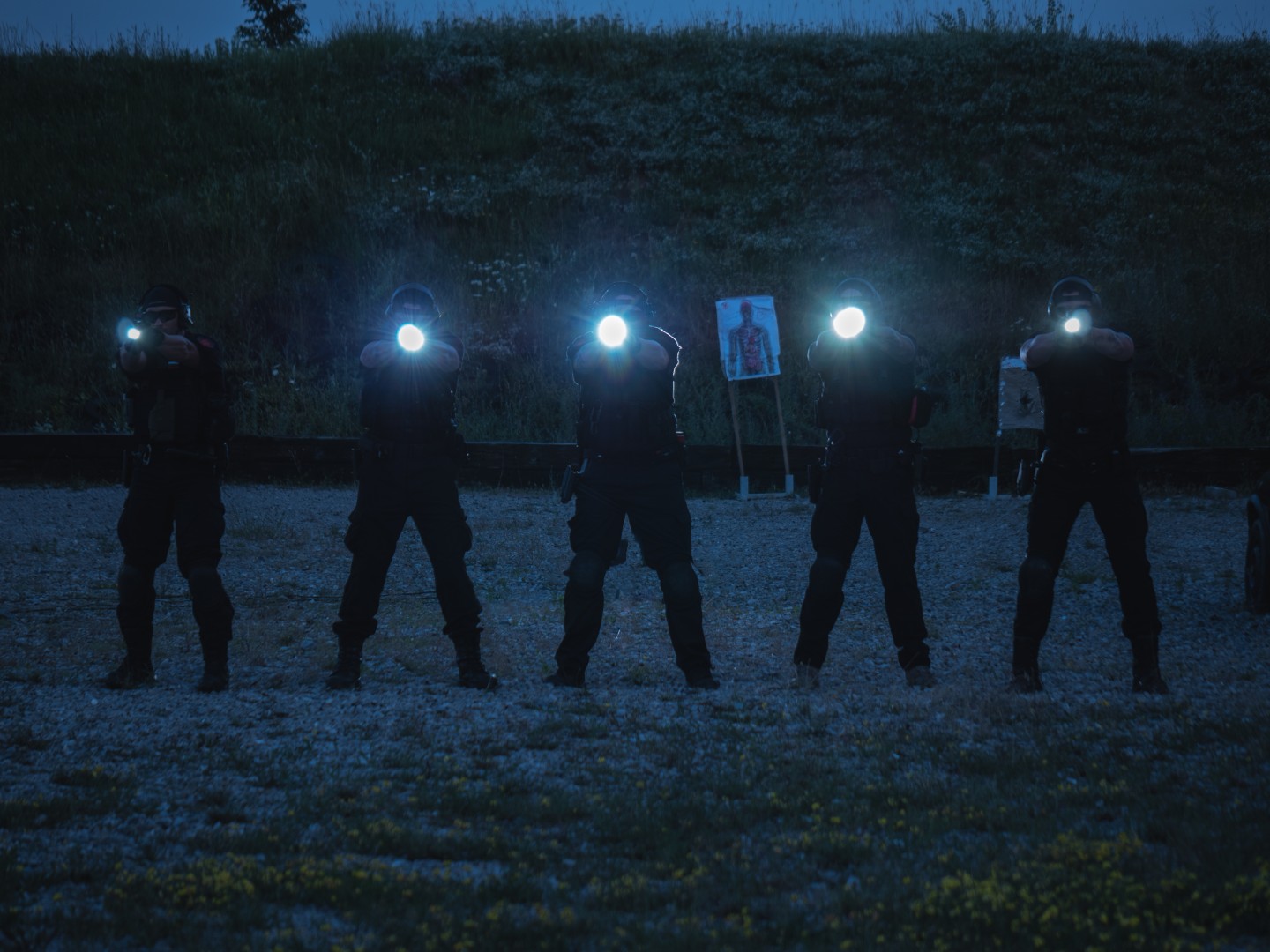
Professional training has one fundamental purpose: to progressively reduce the gap between a controlled exercise and the real conditions in which a particular skill may eventually be required.
First, the technique is developed.
Then movement, time pressure, communication, changing environments, limited information and decision-making are progressively added.
Night operations are part of this process.
Darkness removes some of the information we normally take for granted.
That is precisely why it can expose weaknesses in training so effectively.
Night Operations Training at Alfa-Metal
The Alfa-Metal International Center for Special Training in Bulgaria provides specialised training for operations in low-light and no-light conditions as part of its tactical and professional training programmes.
The training environment allows practical exercises to be conducted at night, while different training programmes can integrate firearms handling, movement, tactical scenarios and the use of specialised optical equipment depending on the specific course.
Night Operations Training can naturally complement other areas of professional preparation, including:
- Tactical Pistol & Carbine Training;
- CQB – Close Quarters Battle;
- Private Military Contractor (PMC) Training;
- Close Protection / PSD Training;
- Tactical Medical Training;
- Mobile Patrol and other specialised tactical programmes.
Explore All Alfa-Metal Training Courses
For students beginning at a fundamental level, the correct progression is to first establish a strong foundation in safe firearms handling and basic shooting skills before gradually moving towards tactical shooting and specialised environments such as Low-Light and No-Light operations.
For already trained professionals, Night Operations Training represents the next step towards being able to apply existing skills effectively in a significantly more demanding environment.
Conclusion: Darkness Does Not Create New Rules – It Reveals How Well You Know the Existing Ones
Night operations involve far more than using a flashlight, night vision device or thermal optic.
They test fundamental professional skills: observation, identification, movement, communication, safety, teamwork and the ability to make the correct decision when information is incomplete.
Modern equipment can significantly expand an operator’s capabilities.
But no piece of equipment can replace proper training.
The real advantage at night is not simply being able to see in the dark.
It is being able to understand what you see, make the right decision and continue to operate safely and effectively when the light is no longer helping you.
Frequently Asked Questions About Night Operations Training
What Is Low-Light Training?
Low-Light Training is specialised preparation for operating in environments with limited illumination. It may include observation, identification, movement, the controlled use of light sources, working with specialised equipment and – at an appropriate level of prior preparation – shooting and tactical exercises.
What Is the Difference Between Low-Light and No-Light?
Low-Light describes an environment in which some illumination is available but visual information is limited or inconsistent. No-Light refers to conditions where natural or artificial illumination is effectively insufficient for normal visual perception and task performance.
Is Night Vision Equipment Required?
Not every low-light exercise requires night vision equipment. Professional training can cover a range of conditions and tools – from working with available ambient light and tactical flashlights to NVGs and other specialised systems.
Are Night Vision and Thermal Optics the Same?
No. Night vision devices generally amplify available light, while thermal imaging systems visualise differences in thermal radiation. The two technologies therefore have different capabilities, advantages and limitations.
Is Night Operations Training Suitable for Beginners?
Specialised Night Operations Training generally builds upon skills that have already been developed. Before progressing to more complex Low-Light and No-Light exercises, participants should have a solid foundation in safe firearms handling and the relevant shooting skills.
Where Does Alfa-Metal Conduct Its Training?
Training at the Alfa-Metal International Center for Special Training takes place at the centre’s dedicated training facility in Bulgaria. Information about current training programmes and upcoming course dates is available in the Courses section of our website.
KEYWORDS:
Low-Light Training, No-Light Training, night tactical training, Night Vision Training, NVG Training, tactical night operations, thermal optics training, low-light shooting, night shooting training, CQB at night, tactical training Bulgaria, tactical training Europe, professional security training Europe